The Stellar Community Fund (SCF) is an open-application awards program that draws on community input to support developers and startups building on Stellar. The SCF Build Award operates in 6-week rounds, including two-step panel review process and community vote.
We received 85 submissions, 50 of which were submitted for their first ever SCF Build awards. Thank you to all submitters and reviewers for your hard work!.
SCF #40 closed out 2025 on a high note, setting a new standard for innovation across the Stellar ecosystem. As the final round of the year, it showcased an impressive wave of forward-thinking ideas and deep collaboration, with teams building alongside existing wallets, on/off-ramps, and DeFi protocols to strengthen the network’s connectivity, usability, and scalability.
These newly awarded SCF Build projects are ambitious, impactful, and well-positioned to drive the next phase of growth as we head into 2026.
24 projects were awarded a total of $2,152,110 worth of XLM.
Click on the project name to view their successful submission! Please note that in order to view the SCF Dashboard, you need to be logged in. If you do not yet have an account, you can create one by signing up with Discord.
Build Award Recipients
Projects can request an SCF Build Award up to $150,000 worth of XLM*. The SCF Build Award is for projects which have significant (user) traction OR teams that are experienced in the Stellar ecosystem and have identified a validated need, both with a well thought out plan and architecture to be ready to build upon receiving the SCF Build Award. Learn more in the SCF Handbook.
Boundless– $110,000 worth of XLM*
Boundless enables builders and funders to collaborate via milestone-based, trustless funding powered by Stellar and Trustless Work.
DeFarm– $90,000 worth of XLM*
DeFarm transforms verified agricultural data into digital assets anchored on Stellar, creating the trusted foundation needed for real-world finance.
Juntta: Web3 Crowdfunding for LATAM — $48,000 worth of XLM*
Juntta is the first transparent crowdfunding platform built in Peru, addressing the trust gap in digital fundraising across Latin America.
Loop — Cashback Everywhere with Stellar — $139,600 worth of XLM*
Loop reimagines everyday spending by combining the discounts, flexibility and global acceptance of gift cards with the power of blockchain-enabled payments.
Houdiniswap — $115,000 worth of XLM*
Houdini Swap is a leading non-custodial, cross-chain liquidity aggregator that unifies DEXs, aggregators, bridges, and centralized providers into one seamless interface.
BPV StellarMesh Anchor — $25,000 worth of XLM*
BPV StellarMesh Anchor connects 300+ exchanges to Stellar for instant SEP-24 funding and global on/off-ramps.
ApiCharge — $79,000 worth of XLM*
ApiCharge (ApiCharge.com) enables direct monetization and complex pricing control of APIs or other digital services, currently in Circle USD, Circle EUR and Stellar XLM.
Diameter Pay– $147,000 worth of XLM*
Diameter Pay is a payments platform providing an API-first infrastructure for USD payments and virtual accounts.
JS-Capacitor Passkey Kit– $10,000 worth of XLM*
JS-Capacitor Passkey Kit is an extension of the Passkey Plugin to support YubiKey hardware devices on all platforms: iOS, Android and web, plus Demo App.
Stellar Unity Developer Kit –$47,000 worth of XLM*
Stellar Unity Developer Kit is a powerful unity-based developer toolkit that allows video game and application developers to easily integrate Stellar smart contracts and blockchain features directly into their C# Unity projects.
Legasi– $93,660.00 worth of XLM*
Legasi is building the first on-chain Lombard lending infrastructure, replicating the private banking model of asset-backed credit, designed for institutional use.
Eara: European regulated RWA ecosystem — $90,000 worth of XLM*
Eara is a pioneering platform for regulated investment asset digitalization in Europe
TheXBank — $89,500 worth of XLM*
TheXBank is a fully licensed digital finance platform offering same-day crypto-to-fiat payouts, multi-currency IBAN services, and cross-border payments in 25+ currencies.
Grant Fox– $60,000 worth of XLM*
GrantFox is an open source collaboration hub for the Stellar ecosystem, allowing projects to receive meaningful contributions and build community, while contributors gain experience and build a portfolio on the network.
Post-Quantum Secure Wallets for Stellar –$150,000 worth of XLM*
Post-Quantum Secure Wallets is building the cryptographic foundation for post-quantum-secure wallets, ensuring Stellar users remain protected against emerging quantum threats.
Splito– $50,000 worth of XLM*
Splito is a settlement platform that bridges the gap between crypto and fiat, making digital assets as simple to use as cash.
HedgePay– $118,600 worth of XLM*
Hedgepay is a self-custodial wallet that gives users direct access to stablecoin savings and curated DeFi investments.
Meria DeFi –$45,000 worth of XLM*
Meria DeFi offers a non-custodial platform helping crypto users generate and track on-chain yields across multiple blockchains.
Stellar Tools– $53,450 worth of XLM*
Stellar Tools builds a suite of Stellar payment adapters that let developers seamlessly enable crypto payments in modern web tools and marketplaces.
ChainPatrol –$100,000 worth of XLM*
ChainPatrol offers a real-time Web3 security platform that helps crypto projects keep their users safe from phishing sites and social threats across 20+ social platforms.
Bevor– $102,000 worth of XLM*
BevorAI is the AI co-pilot for smart contract security — an API and platform that integrates across development, devops, chat, and auditing lifecycles.
Stellars Finance: Cross-Chain Perpetuals– $119,300 worth of XLM*
Stellars Finance is a decentralized perpetual trading protocol built on Soroban, leveraging synthetic assets to enable users to trade any asset even if it doesn’t exist natively on the Stellar network.
Bingtellar– $120,000 worth of XLM*
Blink lets anyone send single or bulk payments globally with just a link — seamless USDC transfers to email or phone that automatically earn yield.
Confidential Transfers and Balances– $150,000 worth of XLM*
Confidential Transfers and Balances is creating a platform where Stellar builders can add confidential amounts and balances with selective disclosure for compliance without reinventing encryption.
Stellar Passport– $150,000 worth of XLM*
Stellar Passport is a passkey-based onboarding tool that gives every user an instant embedded wallet and a simple way to earn verifiable on-chain stamps creating a portable record for the Stellar ecosystem.
A huge congratulations to these incredible projects! Your innovation reflects the best of what our ecosystem can achieve. We’re excited to collaborate with you and help bring your ideas to life in a way that drives meaningful, lasting change.
Round Insights & Voting Dynamics
Since October 2023, the Stellar Community Fund (SCF) has utilized Neural Quorum Governance (NQG), a reputation-based voting mechanism to signal community sentiment in Award Allocation in the Community Vote phase of SCF Build. Voting results are non-determinative, and final allocation decisions are made by the quarterly delegates panel.
Given the high number of submissions in the SCF #40 Community Vote (the final round of the year), several insights emerged when tallying results — most notably the impact of voter apathy — and slightly delayed award processing time.
Voter apathy has been a compounding challenge and was particularly visible this round. Many voters only had capacity to deeply review a limited number of proposals, resulting in some projects receiving insufficient attention during the Community Vote and being voted down despite potential merit. This issue is being directly addressed in the upcoming SCF v7.0 redesign in early 2026, which will introduce a more streamlined review and voting process.
Delegate Discussion Overview
To move forward in SCF #40, Quarterly Delegates engaged in two weeks of detailed discussion to assess projects that did not meet the >75% Voting Weight approval threshold. These discussions focused on review completeness, technical and compliance risk, delivery credibility, budget clarity, and demonstrated ecosystem value — surfacing additional context that was not always fully captured during the Community Vote itself.
Based on this collective assessment, an additional 14 projects were selected for funding. These decisions were made independently of Voting Weight received to ensure high-quality, strategically valuable projects were not excluded due to participation constraints in the broader vote. See full results here.

Participation Statistics
SCF #40 saw a slight decrease in unique voter participation from SCF #39 with 81 Delegatees and 27 Active Voters, but still keeping in line with the recent quarter’s growth. The overall growth in Q4 2025 signals interest from both long-time contributors and new community members.
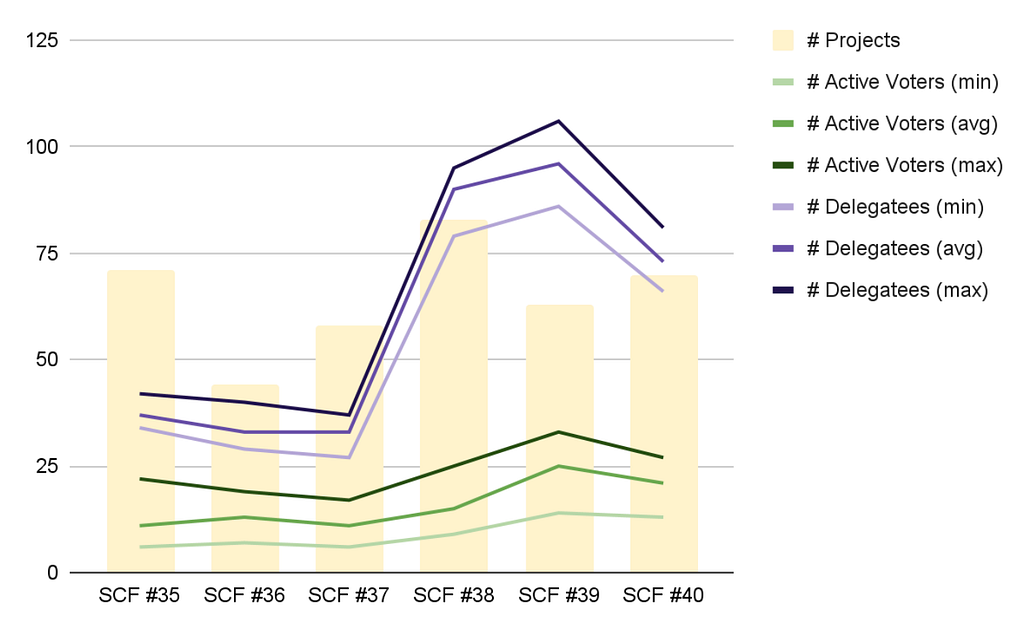
While preserving individual voter privacy in the public report, additional analysis of voter composition suggests several structural dynamics may be influencing participation:
- The majority of voters fall into the Pilot or Pathfinder tiers, with very limited participation from Navigators.
- Over 40% of voters are team members of SCF-awarded projects, while another 40% hold no role beyond their verified tier.
One hypothesis is that participation is currently skewed toward contributors with either direct incentives to engage (Quarterly Delegates operating at the Pilot level and active project teams) or low participation barriers (Pathfinders). Limited Navigator participation appears to largely reflect the relatively small Navigator cohort overall, as well as structural friction in progressing from Pathfinder to Navigator. A proposal to address these progression bottlenecks and improve clarity in role advancement is currently under review and is expected to be implemented in the new year.
Quorum Adjustments
As noted in the SCF #39 Recap, the SCF #40 Community Vote increased the minimum quorum size from 5 to 7 to improve consensus quality while maintaining inclusiveness. Consensus was calculated using the largest available quorum to strengthen result reliability.
Following the resolution of previously identified issues in the Quorum Delegation setup, the approval threshold was restored to its original level of 67%. In SCF #38 and #39, this threshold had been temporarily reduced to 51% as a compensatory measure (see SCF #39 Recap to learn more).
Neuron Schema Updates
SCF #40 introduced no new neurons. However, the results continue to support the hypothesis from SCF #39 that recent neuron adjustments in the Discord Tier Neuron are contributing to a more balanced distribution of voting power.
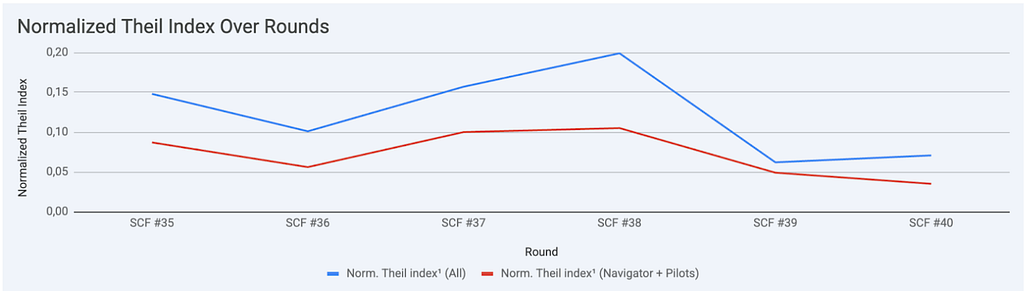
While the concentration of voting weight among the top five voters increased slightly to 21.5% (up from SCF #39), this appears to be driven by a modest decline in delegation activity — primarily among Pathfinders — rather than structural imbalance. Importantly, the Theil index¹ remains low, continuing the trend of reduced inequality across voters.
That said, the overall distribution of voting power across the four neurons remains heavily dependent on the Assigned Trust neuron, consistent with SCF #39 and earlier rounds. Over 50% of voters are not included on any trusted lists (predominantly Pathfinders), while the maximum Assigned Trust value reached 12.28, indicating the presence of significant outliers with disproportionately high trust assignments.
Because the Assigned Trust neuron relies on voters actively maintaining their trusted lists to reflect an accurate PageRank trust graph, infrequent updates materially limit its effectiveness. In practice, many voters do not regularly revisit or comprehensively update their trusted lists due to UX friction and time costs. While several UX improvements are underway in early 2026, additional work is needed to help the community more easily discover and recognize emerging high-quality contributors — particularly within Discord — so they can be confidently added to trusted lists.
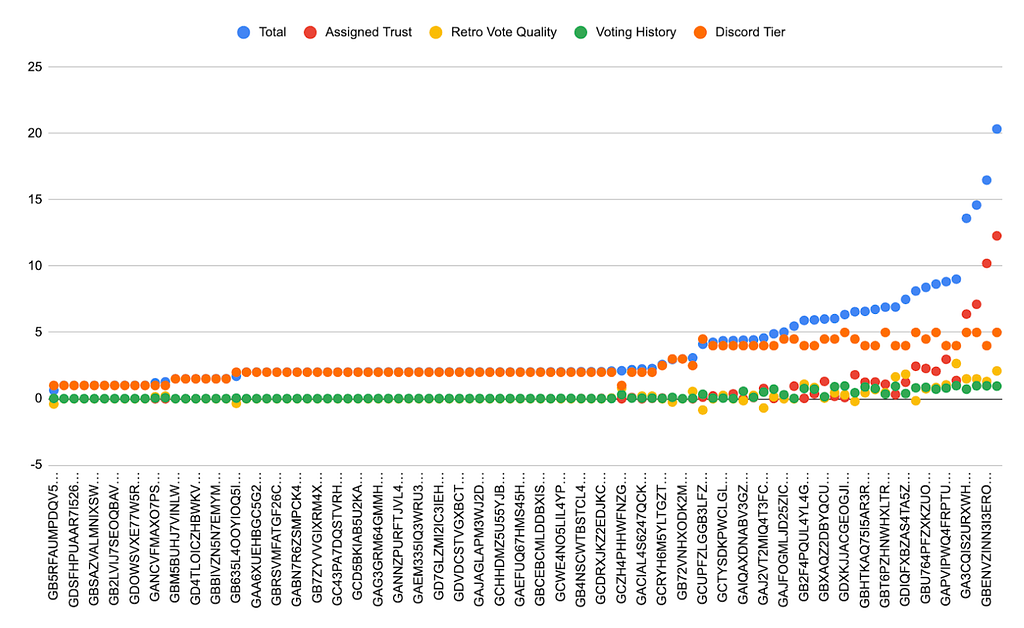
Among the remaining neurons, the Voting History neuron currently has a relatively modest impact on total voting power, but shows strong potential for future rounds. Early analysis suggests that increasing its influence would broadly reward consistent participation and distribute incremental voting weight across a wider set of engaged contributors — supporting clearer progression pathways from Pathfinder to Navigator.
The Vote Quality neuron, by contrast, exhibits higher volatility and is therefore intentionally kept at a lower influence for now. Additional rounds of data are needed to ensure its signals are stable and representative of broader community behavior before increasing its weight.
Looking Ahead
Now that SCF #40 is concluded, a two-year analysis of the NQG in practice and its impact on community-driven funding will be published early next year. If you’re interested in participating in the community vote and helping to shape the future of the Stellar ecosystem, become verified today and participate in the discussion on the Stellar Dev Discord!
*The USD valuation of the Award in XLM is calculated using the CF Stellar Lumens-Dollar Settlement Price on the day of payment as administered, maintained, and reported by the cryptocurrency index provider CF Benchmarks Ltd. (using the ticker XLMUSD_RR) (available at https://www.cfbenchmarks.com/indices/XLMUSD_RR).
SCF #40 Round Recap was originally published in Stellar Community on Medium, where people are continuing the conversation by highlighting and responding to this story.